Quick answer
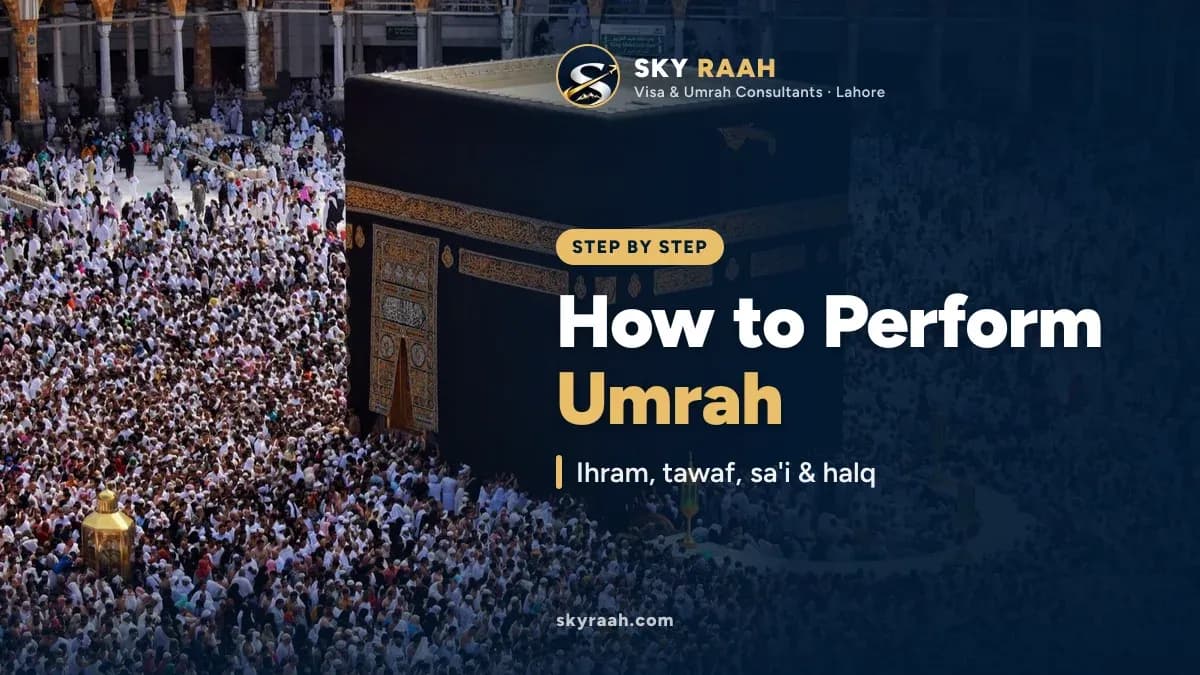
Umrah has four main steps. Enter ihram before the miqat with the intention and the talbiyah. Perform tawaf: seven anticlockwise circuits of the Kaaba starting at the Black Stone, then pray two rak'ahs. Perform sa'i: seven laps between Safa and Marwah, starting at Safa and ending at Marwah. Finally, men shave or shorten their hair and women cut a fingertip's length, which ends ihram.
In this guideShow
- What are the steps of Umrah?
- Before you start: permits and preparation
- Step 1: How do you enter ihram from Pakistan?
- Step 2: How do you perform tawaf?
- Step 3: How do you perform sa'i?
- Step 4: How do you finish Umrah with halq or taqsir?
- Tips for women, elderly pilgrims and children
- Common mistakes to avoid
- How Sky Raah can help
- Official sources
Most first-time pilgrims worry more about getting the rituals right than about the visa or the flight. The good news is that Umrah is short and clear. This guide explains how to perform Umrah step by step for pilgrims travelling from Pakistan, from putting on ihram at home to cutting your hair at the end.
It follows the widely agreed practice set out in Saudi Arabia's official Nusuk Umrah journey guide. The Ministry of Hajj and Umrah's Umrah and Visit Guide, available in 16 languages, covers the same steps along with miqat locations and mosque etiquette. Where the schools of thought (Hanafi, Shafi'i, Maliki and Hanbali) differ, we say so briefly. For any detail of your own situation, ask a scholar you trust.
What are the steps of Umrah?
Umrah has four core steps, always performed in this order:
| Step | What you do | Where |
|---|---|---|
| 1. Ihram | Enter the sacred state with the intention and the talbiyah | Before the miqat |
| 2. Tawaf | Walk seven circuits around the Kaaba, then pray two rak'ahs | Masjid al-Haram |
| 3. Sa'i | Walk seven laps between the hills of Safa and Marwah | Masjid al-Haram (the Mas'a) |
| 4. Halq or taqsir | Shave or shorten the hair, which ends ihram | Makkah |
Scholars classify these steps slightly differently. For example, some schools treat ihram, tawaf and sa'i as pillars and the hair-cutting as obligatory, while the Hanafi school counts sa'i as obligatory rather than a pillar. The practical sequence is the same for everyone.
Before you start: permits and preparation
You need an Umrah visa and an Umrah permit booked in the Nusuk app for a set date and time. The Ministry of Hajj and Umrah's FAQ says entry to the Haram for Umrah is tied to your permit time, while prayer in the mosque is allowed at any time. Our Umrah visa and Nusuk guide explains how to book it.
Before you leave home:
- Get your vaccinations done in time (see our Umrah vaccination guide)
- Learn the talbiyah and a few short duas you know well. You can make dua in Urdu or any language
- Pack your ihram in your hand luggage, using our Umrah packing list
Step 1: How do you enter ihram from Pakistan?
Ihram is the sacred state a pilgrim enters for Umrah. It starts with the intention (niyyah), not just with putting on the clothes.
Prepare at home or at the airport
- Clean yourself. Trim nails, remove unwanted body hair and take a bath (ghusl). This is sunnah, not compulsory.
- Men may apply perfume to the body (not the ihram cloth) before the intention. Women should not wear perfume in public.
- Put on the ihram clothing. Men wear two plain unstitched white sheets and sandals. Women wear their ordinary loose, modest clothing.
- Pray two rak'ahs if it is not a disliked time for prayer. Many scholars say this is recommended rather than required.
Many Pakistani pilgrims do all of this at home or at the airport, because changing on a full plane is difficult.
Make the intention before the miqat
A miqat is a boundary that a pilgrim heading to Makkah must not cross without being in ihram. Flights from Pakistan to Jeddah pass the miqat zone in the air, and the crew normally announce it some time before. When you hear the announcement (or a little before, to be safe):
- Make the intention in your heart for Umrah. You may say: "Labbayka Allahumma 'Umrah" (Here I am, O Allah, for Umrah).
- Begin the talbiyah and repeat it often until you start tawaf:
Labbayk Allahumma labbayk. Labbayka la sharika laka labbayk. Innal-hamda wan-ni'mata laka wal-mulk. La sharika lak.
Jeddah airport is inside the miqat boundary, so most scholars say pilgrims flying in from Pakistan should not wait until they land to enter ihram. A minority view treats Jeddah as a miqat for arriving travellers; if you are considering this, ask a scholar first.
If you go to Madinah first
If you fly to Madinah and spend a few days there first, you do not need ihram on the flight. You enter ihram when you leave Madinah for Makkah, at the miqat of Dhul Hulayfah (also called Abyar Ali), just outside Madinah. Buses usually stop there.
What is not allowed in ihram?
Once you have made the intention, these are not allowed until Umrah is complete:
- Perfume or scented products, on the body or clothes
- Cutting or removing hair or nails
- Marital relations, and making a marriage contract
- Hunting land animals
- Men: wearing stitched clothing shaped to the body (shirts, trousers, underwear) and covering the head
- Women: wearing a face veil (niqab) or gloves
If you break one of these by mistake, the ruling differs between schools and depends on what happened. Ask a scholar in Makkah; your operator can usually connect you with one.
Step 2: How do you perform tawaf?
Tawaf means walking seven circuits around the Kaaba.
- Enter Masjid al-Haram with your right foot, saying the dua for entering a mosque.
- Stop the talbiyah when you begin tawaf.
- Men uncover the right shoulder (idtiba) by passing the upper sheet under the right arm. This applies only during this tawaf.
- Start at the Black Stone corner. Face the Black Stone (or the line marking it, usually shown by a green light on the wall), raise your right hand towards it and say "Bismillah, Allahu Akbar". You do not need to touch or kiss it; in crowds, pointing is the sunnah and pushing to reach it harms others.
- Walk anticlockwise, with the Kaaba on your left. Make any dua you like, in any language, or recite Quran.
- Men walk briskly (raml) in the first three circuits if they can, and walk normally in the last four. Women walk normally throughout.
- Between the Yemeni corner and the Black Stone, many pilgrims recite: Rabbana atina fid-dunya hasanah, wa fil-akhirati hasanah, wa qina 'adhaban-nar.
- Each time you reach the Black Stone line, raise your hand and say "Allahu Akbar". Seven circuits complete the tawaf.
Walk outside the semicircular wall (the Hijr Isma'il), not through it, because it is part of the Kaaba.
Two rak'ahs and Zamzam
After tawaf, men cover the right shoulder again. Pray two rak'ahs behind Maqam Ibrahim if there is space, or anywhere in the mosque if it is crowded. Many pilgrims then drink Zamzam water, which is available from coolers throughout the mosque.
Step 3: How do you perform sa'i?
Sa'i means walking between the hills of Safa and Marwah, remembering Hajar (peace be upon her) searching for water for her son.
- Go to Safa (follow the signs to the Mas'a). On reaching it, many pilgrims recite: Innas-Safa wal-Marwata min sha'a'irillah.
- Face the Kaaba, raise your hands in dua and say "Allahu Akbar" three times, with any dua you wish.
- Walk towards Marwah. Between the two green lights, men jog lightly if they can; women walk normally.
- At Marwah, face the Kaaba and make dua again. That is one lap.
- Walk back to Safa for lap two, and continue. Seven laps end at Marwah.
Sa'i has several floors and a lane for wheelchairs. The Ministry's FAQ says electric carts for tawaf and sa'i are available on specific floors and can be rented through the Tanaqul app, which helps elderly parents.
Step 4: How do you finish Umrah with halq or taqsir?
The final step ends the state of ihram.
- Men either shave the whole head (halq), which is more rewarded, or shorten the hair evenly from all over the head (taqsir). Barbers are located near Marwah and around the Haram.
- Women cut about a fingertip's length (Nusuk gives roughly 1–2 cm) from the ends of their hair, gathered together. This is done privately, not in front of men.
After this, everything that was not allowed in ihram becomes allowed again, and your Umrah is complete. Nusuk's guide notes that the prohibitions of ihram remain in force until the hair is cut, so do not delay it. Hanafi scholars also hold that the hair should be cut within the Haram boundary, which is another reason to do it in Makkah.
Tips for women, elderly pilgrims and children
- Women: a woman who is menstruating can enter ihram and do everything except tawaf. The widely agreed position is that she waits until her period ends, takes a bath, and then performs tawaf and sa'i. If her return flight is before that, scholars differ on what she should do, so ask a scholar early.
- Elderly parents: perform tawaf on an upper floor or use a wheelchair or electric cart. Choose a quieter time, such as mid-morning.
- Children: a child's Umrah is valid, but most scholars say it does not replace the Umrah they may perform as an adult. See our upcoming guide on Umrah with children.
Common mistakes to avoid
- Crossing the miqat without ihram, usually by waiting to land in Jeddah.
- Using scented wet wipes or soap after making the intention.
- Pushing to touch the Black Stone, which harms others and is not required.
- Walking through the Hijr Isma'il during tawaf.
- Starting sa'i at Marwah instead of Safa.
- Cutting only a few strands of hair instead of shortening it evenly (for men).
- Arriving without a valid Nusuk permit, or missing your slot.
How Sky Raah can help
Sky Raah Travels arranges Umrah packages from Lahore with hotels in Makkah and Madinah, transport and help with Nusuk permits. Our pre-departure briefing walks first-time pilgrims through these steps so they arrive calm and prepared. For religious questions, we always recommend speaking to a qualified scholar.
Official sources
- Nusuk: Umrah journey guide
- Ministry of Hajj and Umrah: Umrah and Visit Guide
- Ministry of Hajj and Umrah: FAQ
- Nusuk: official pilgrim platform
Permit rules and mosque arrangements change, especially in peak seasons. Check the Nusuk app and the Ministry of Hajj and Umrah before you travel.
Frequently asked questions
How long does it take to perform Umrah?
The Ministry of Hajj and Umrah's Umrah and Visit Guide estimates about two to three hours on foot, or one and a half to two hours using an electric cart. Crowds, the floor you use and your pace can make it longer. Tawaf on the ground floor near the Kaaba is shorter but slower in crowds; upper floors are longer but often move more freely. Allow extra time in Ramadan and on Fridays.
Do I need wudu for tawaf and sa'i?
The majority of scholars hold that wudu is a condition for tawaf, so if you lose it you should renew it and continue. Wudu is recommended but not required for sa'i according to most scholars. If your wudu breaks during tawaf, ask a scholar how to continue, as the schools differ on whether to restart.
Can I perform Umrah on behalf of a deceased parent?
Many scholars allow performing Umrah on behalf of a deceased person or someone unable to travel, provided you have already performed your own Umrah. You make the intention for them when entering ihram. Because details differ between schools, ask a scholar before you travel.
What if I forget how many rounds I have completed?
Scholars generally advise building on the number you are sure of, which is the lower number, and completing the rest. A small counter or a tasbeeh ring helps you keep track in crowds. Many pilgrims also mark each round with a brief pause at the Black Stone line.
Do I need a Nusuk permit to perform Umrah?
Yes. Pilgrims need an Umrah permit booked through the Nusuk app for a specific date and time. The Ministry of Hajj and Umrah says entry to the Haram for Umrah is tied to the permit time, although you can pray in the mosque at any time. Book the permit once your visa is issued.
Need help with your application?
See our Umrah packages from Pakistan guide, or talk to our Lahore team.
Written by
Visa & Umrah consultants, Lahore
The Sky Raah Travels team prepares visit visa files and Umrah bookings for Pakistani travellers from our Lahore office.